

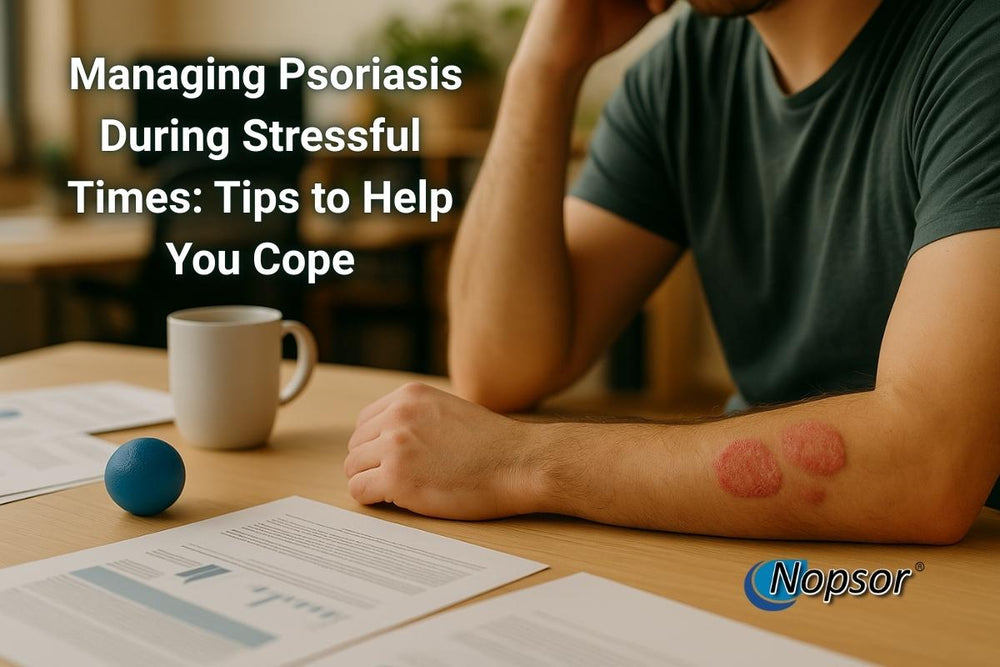
Introduction: When Stress and Psoriasis Collide
You’re juggling work, family, and daily responsibilities when—bam!—a psoriasis flare-up shows up right before a big presentation, date, or family gathering. Stress is one of the most common triggers for psoriasis, and flare-ups often arrive at the worst possible moments.
The truth is, stress and psoriasis feed each other. Stress sparks flares. Flares create stress. That cycle can leave you exhausted, anxious, and feeling powerless. But you’re not powerless. While you can’t erase stress from life, you can change how it affects your skin, your confidence, and your peace of mind.
This guide explores how stress impacts psoriasis, and it gives you practical tools, daily habits, real-life scripts, and professional support strategies to help you manage both stress and your skin, so you can step back into your life with more confidence.
How Stress Triggers Psoriasis Flare-Ups
Psoriasis is an autoimmune condition, the immune system mistakenly attacks healthy skin cells, causing inflammation, redness, and scaling. Stress makes this reaction worse:
- Cortisol overload: Stress floods your body with cortisol, a hormone that increases inflammation.
- Immune disruption: Chronic stress weakens immune balance, making psoriasis harder to control.
- Lifestyle fallout: Stress often leads to poor sleep, emotional eating, skipped routines, and less exercise, all of which worsen flares.
A customer once described it as
“The cruelest timing, right before my exams, my plaques doubled. It felt like my skin was punishing me for being stressed.”
That’s the vicious cycle so many face. The goal is to interrupt it, not by removing stress entirely, but by changing how you respond to it.
10 Daily Habits to Reduce Stress and Calm Psoriasis
1. Start Your Day with a Calming Morning Routine
Why It Helps: Mornings set the tone. A rushed start raises cortisol before you even leave the house.
- Wake up 15 minutes earlier to avoid rushing.
- Stretch or do a short meditation.
- Drink a glass of water before coffee.
💡 Pro Tip: Keep a gratitude journal. Writing three positives helps anchor your mindset before stress builds.
2. Practice Deep Breathing Throughout the Day
Why It Helps: Breathing slows the stress response and lowers cortisol.
- Try the 4-7-8 method: Inhale 4 sec, hold 7, exhale 8.
- Use apps like Calm or Headspace.
- Pause and breathe before reacting to stressful situations.
💡 Pro Tip: Pair breathing with relaxing music or essential oils for extra calm.
3. Stick to a Skincare Routine (Even When You’re Busy)
Why It Helps: Stress makes people skip routines, but psoriasis thrives on inconsistency.
- Moisturize daily with fragrance-free lotion.
- Take lukewarm, not hot, showers.
- Apply treatments regularly.
💡 Pro Tip: Apply Nopsor’s treatment before bed to support skin repair while you sleep.
4. Move Your Body (But Don’t Overdo It)
Why It Helps: Movement releases endorphins, lowers inflammation, and resets mood.
- Gentle yoga, stretching, or walking are best.
- Avoid overheating or friction-heavy workouts.
- Stretch before bed to help with relaxation.
💡 Pro Tip: Swimming is psoriasis-friendly, the water cools skin and reduces irritation.
5. Watch Your Diet (Stress Eating Can Worsen Psoriasis)
Why It Helps: Sugary, processed “comfort foods” trigger inflammation.
- Choose anti-inflammatory foods (salmon, leafy greens, berries).
- Cut back on sugar, alcohol, and highly processed foods.
- Keep healthy snacks ready.
💡 Pro Tip: Prep trail mix or Greek yogurt so stress doesn’t push you toward fast food.
6. Prioritize Quality Sleep
Why It Helps: Poor sleep = higher inflammation + itchier skin.
- Stick to a consistent bedtime routine.
- Use blackout curtains and a cool bedroom.
- Avoid screens before bed.
💡 Pro Tip: If itching wakes you, apply a cooling moisturizer to calm the skin.
7. Set Boundaries & Say No to Extra Stress
Why It Helps: Overcommitment = burnout and flare-ups.
- Decline tasks or invites that drain your energy.
- Protect time for recovery.
- Take short breaks throughout the day.
Customer Script Example:
“Thanks for thinking of me. I can’t take this on right now, but I’ll let you know when I can.”
8. Get Fresh Air & Natural Light
Why It Helps: Sunlight boosts Vitamin D, improves mood, and reduces cortisol.
- Take a 10-minute outdoor break daily.
- Try grounding: walk barefoot on grass or sand.
- Open windows for natural light if stuck inside.
💡 Pro Tip: Even sitting by a sunny window can lift your mood.
9. Join a Support Group (You’re Not Alone)
Why It Helps: Connection reduces isolation and stress.
- Join online communities.
- Share with trusted friends or a therapist.
- Explore local psoriasis groups if available.
💡 Customer Insight:
“Hearing someone else say they also hide flakes in the office made me feel instantly less alone.”
10. Do Something That Makes You Happy Every Day
Why It Helps: Joy lowers stress hormones and builds resilience.
- Read, paint, laugh, or listen to music.
- Write down three things you’re thankful for.
- Make space for hobbies.
💡 Pro Tip: Even five minutes of joy daily can shift stress patterns.
Stress in Real-Life Situations: Scripts You Can Use
Stress doesn’t just live in your head, it shows up in real-life situations. Here are practical scripts you can use in the moment:
At Work
Deadline pressure:
“I’ll break this down into smaller steps and tackle them one by one.”
Coworker stares:
“It’s psoriasis. Not contagious — just my skin acting up.”
Job interview nerves:
“I manage psoriasis, but it doesn’t affect my ability to work or focus.”
At Home
Family says “Just relax”:
“I know you want to help. Psoriasis isn’t about relaxing, but your support means a lot.”
Partner intimacy:
“These patches may look uncomfortable, but they’re not contagious. I’d love to focus on us.”
Children’s questions:
“My skin makes flakes sometimes, like snow. It doesn’t hurt you — it’s just part of me.”
Financial Stress
Insurance challenges:
“This is frustrating, but I’ll keep pushing until I get the coverage I need.”
Social Settings
Turning down an invite:
“Thanks for including me. I’ll join when I’m feeling more comfortable.”
At a restaurant:
“It’s psoriasis. Not contagious — I’m fine, just being mindful of what I eat.”
Why Therapy Can Help
Stress from psoriasis is not “all in your head.” It’s real, and it affects both mental and physical health. Professional support can make a huge difference:
Cognitive Behavioral Therapy (CBT)
- Helps challenge thoughts like: “Everyone is staring at me.”
- Reframes them into: “Some may notice, but I can’t control them. I can control my confidence.”
Mindfulness-Based Therapy
- Reduces overthinking by focusing on the present moment.
- Builds calm responses to itching and flares.
Counseling & Supportive Therapy
- Offers a safe space to talk about rejection, intimacy, or work stress.
- Builds resilience by validating your feelings and teaching coping skills.
Customer Reflection:
“Therapy taught me that avoiding mirrors didn’t protect me — facing them with compassion did.”
If stress or depression feels overwhelming, reaching out for therapy is not weakness, it’s a form of strength.
When Stress Becomes Too Much
Sometimes stress crosses a line. Watch for:
- Constant exhaustion.
- Feeling “trapped” in a flare.
- Anxiety or sadness that doesn’t lift.
If that happens:
- Reach out for therapy.
- Use Employee Assistance Programs if your workplace offers them.
- Talk with your doctor about treatment adjustments.
Reframing Stress: From Weakness to Resilience
Stress will never disappear. But each time you manage a flare under pressure, set a boundary, or choose rest, you prove your resilience. Living with psoriasis while balancing work, family, and social life takes strength most people don’t see.
Customer Story:
“I used to think stress meant I was failing. Now I see it as proof that I keep showing up, even when it’s hard.”
Nopsor’s Approach: Relief That Supports Peace of Mind
At Nopsor, we understand that psoriasis care is more than treating skin, it’s caring for the whole person. Our nightly treatment routine supports skin repair while you rest, giving both physical relief and emotional peace of mind.
Because managing psoriasis isn’t just about symptoms, it’s about reclaiming dignity, confidence, and a full life.
Conclusion
Stress will always be part of life. But psoriasis doesn’t have to control your confidence or your choices. By combining daily habits, real-life coping scripts, therapy support, and a resilient mindset, you can break the stress-flare cycle and step back into your life with strength.
Further Reading:
-
Understanding the Emotional Impact of Psoriasis — Why psoriasis affects mood, self-esteem, and daily life—and how to cope.
-
Psoriasis and Self-Esteem: Building Confidence with Visible Symptoms — Practical ways to rebuild confidence while living visibly with psoriasis.
-
Handling Questions About Your Psoriasis with Confidence — Short scripts for stares, comments, dating, and work conversations.
References
-
Bhutani, T., Koo, J., Heim, J., Bhatia, N., Mathew, J., Ferro, T., & Vasquez, J. G. (2024). Improvements in psoriasis-related work productivity with tildrakizumab: Results from a Phase 4 real-world study in patients with moderate-to-severe plaque psoriasis. Dermatology and Therapy, 14, 1019-1025.
Summary: This open-label Phase 4 study found that treatment with tildrakizumab significantly reduced work productivity loss and daily activity impairment over 64 weeks in patients with moderate-to-severe plaque psoriasis. -
Effect of Psychological Intervention on Quality of Life Among Patients With Psoriasis. (2024). Behavioral Medicine / Springer.
Summary: A systematic review showing CBT, mindfulness, and other psychological interventions improve anxiety, depression, and overall quality of life for psoriasis patients. -
Hidden Costs of Psoriasis: A Population-Based Study Evaluating How Psoriasis Severity Impacts Work Absenteeism. (2024). Journal of Drugs in Dermatology, 23(8), 640-644.
Summary: Adults with moderate-to-severe psoriasis had significantly more work absenteeism than mild cases, illustrating how disease severity correlates with real professional and financial burden. -
P22 Psoriasis: Impact on Mental Health. (2024). British Journal of Dermatology, 191(Supplement 3), ljae360.052.
Summary: A recent literature review (2019-2024) showing psoriasis is strongly associated with depression, anxiety, low quality of life; visibility and social stigma are major contributing factors.
Leave a comment
Also in Psoriasis Lifestyle Tips
What to Do When You Feel ‘Undateable’ Because of Psoriasis
August 19, 2025
When psoriasis makes you feel unworthy of love, rejection can feel personal. This guide helps you rebuild your confidence, one gentle truth at a time.
Continue reading
Real Stories: Dating Rejections and How People Bounced Back
July 07, 2025
Ghosted, judged, dismissed these real stories reveal the emotional weight of dating rejection with psoriasis, and how people found the courage to move forward.
Continue reading
Can You Be Intimate with Psoriasis? What You Need to Know
July 06, 2025
Worried that psoriasis might get in the way of intimacy? Learn how to prepare, communicate, and feel confident in your body and relationships right now.
Continue reading